
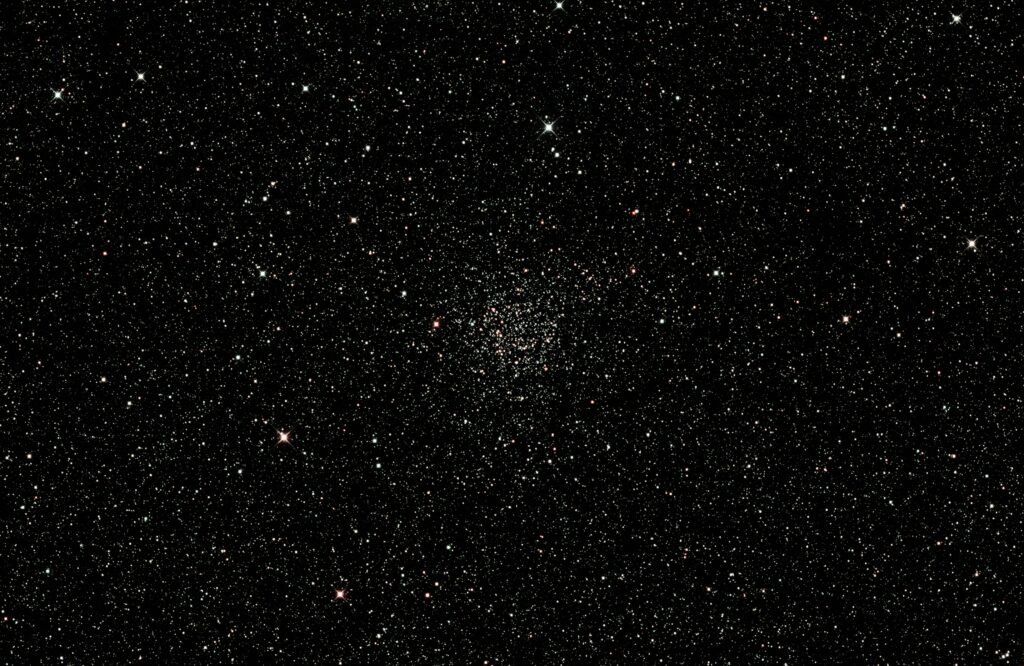
NGC 7789 – Caroline’s Rose in Cassiopeia
Here is my image of the beautiful open star cluster NGC 7789, also known as “Caroline’s Rose” or “The White Rose Cluster.” It’s located about 8,000 light-years away in the constellation Cassiopeia. From our viewpoint on Earth, it takes up an area of the sky about half the width of the full Moon, but in reality, this massive collection of stars is enormous, spanning over 40 light-years from end to end.
What makes this target so interesting is its age. At roughly 1.6 billion years old, it’s a senior citizen among open clusters. Because of its age, the most massive, hot-burning blue stars from its youth have already evolved into the prominent orange and red giants that you can see scattered throughout the image. These older, colorful stars create a stunning contrast with the hundreds of smaller, yellow-white stars, giving the cluster its unique character.
Equipment
- Telescope: Celestron RASA 11
- Imaging Camera: ZWO ASI2600MC Pro
Acquisition & Processing Details
- Total Integration: 9.5 hours
- Light Frames: 192 x 180s (3 minutes)
- Calibration Frames: 3 Darks, 10 Flats, 10 Dark Flats
The software workflow was key to bringing out the detail in this deep dataset.
- The entire capture session was automated and controlled using NINA.
- All 192 light frames and the calibration files were stacked and integrated in DeepSkyStacker.
- GraXpert was then used for the heavy lifting of processing. It did a fantastic job removing background gradients and handling the initial, non-linear stretch of the data to bring the faint details of the cluster to life.
- Finally, I took the stretched image into Affinity Photo for the final touches, focusing on color balance, enhancing contrast, and applying a bit of sharpening to make the stars pop.