
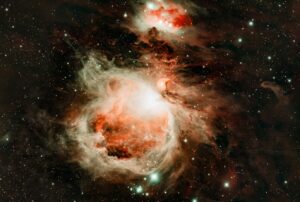
The Orion Nebula, also known as M42, is a vast stellar nursery located approximately 1,344 light-years away in the constellation of Orion. It's one of the brightest nebulae in the night sky and can be seen with the naked eye as a fuzzy patch in the "sword" that hangs from Orion's belt. This magnificent cloud of gas and dust is a region of intense star formation, where thousands of new stars are being born. At its heart lies the Trapezium, a young open cluster of hot, massive stars whose intense ultraviolet radiation causes the surrounding gas to glow, creating the beautiful spectacle we can observe. The nebula's intricate structure is a dynamic environment where protoplanetary disks, the building blocks of solar systems, have been observed.
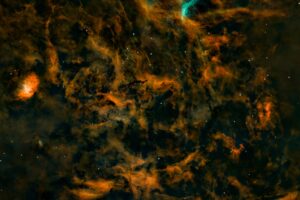
Cygnus: A Symphony of Stellar Winds In the heart of Cygnus, three celestial marvels converge: Wolf-Rayet 134, a rare, massive star shedding its outer layers in fierce stellar winds; the Tulip Nebula (Sh2-101), glowing softly with ionized hydrogen near the energetic micro quasar Cygnus X-1; and the Crescent Nebula (NGC 6888), sculpted by the turbulent winds of WR 136, its arcs glowing in oxygen and hydrogen light. Together, they form a dynamic portrait of stellar evolution—massive stars shaping the interstellar medium with light, heat, and motion.
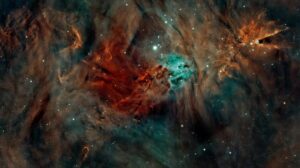
The Cone Nebula (NGC 2264) The Cone Nebula is a towering pillar of cold gas and dust, part of a much larger star-forming region. This dark, imposing structure, roughly 7 light-years tall, is being sculpted by the powerful stellar winds and intense radiation from massive young stars above it. o put that in perspective, the Cone Nebula would stretch across the equivalent of approximately seven thousand of our solar systems lined up end-to-end!" The Fox Fur Nebula (Sh2-273) The Fox Fur Nebula is a vibrant, reddish emission nebula that gets its name from its wavy, fur-like appearance. It's also part of the same colossal NGC 2264 complex, illuminated primarily by the hot, massive star S Monocerotis. This vast cloud of ionized hydrogen gas spans an area of many light-years, continuously glowing as it's energized by the intense radiation from nearby young stars. Its sheer size means it could easily engulf tens of thousands of our solar systems, with plenty of room to spare, highlighting the enormous scale of cosmic nurseries where stars are born.
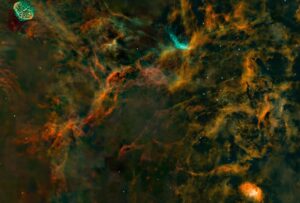
Cygnus: A Symphony of Stellar Winds In the heart of Cygnus, three celestial marvels converge: Wolf-Rayet 134, a rare, massive star shedding its outer layers in fierce stellar winds; the Tulip Nebula (Sh2-101), glowing softly with ionized hydrogen near the energetic micro quasar Cygnus X-1; and the Crescent Nebula (NGC 6888), sculpted by the turbulent winds of WR 136, its arcs glowing in oxygen and hydrogen light. Together, they form a dynamic portrait of stellar evolution—massive stars shaping the interstellar medium with light, heat, and motion.
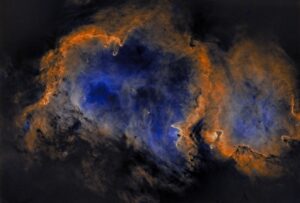
IC 1848 — The Soul Nebula Located in the constellation Cassiopeia, about 7,500 light-years away, the Soul Nebula is a sprawling star-forming region shaped by the winds and radiation of massive young stars. Its glowing clouds of hydrogen cradle several open clusters, while dense pillars of gas—some spanning 10 light-years—harbor newborn stars at their tips. Often paired with its neighbor, the Heart Nebula, this region pulses with the rhythm of stellar creation
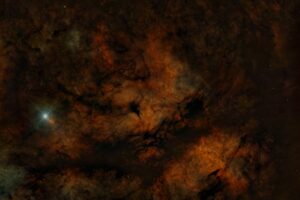
Sadr & the Heart of Cygnus At the center of the Northern Cross lies Sadr, a luminous yellow-white supergiant about 1,800 light-years away. Surrounding it is the Sadr Region Nebula (IC 1318)—a vast, glowing tapestry of ionized hydrogen, dark dust lanes, and star-forming clouds. Though Sadr appears embedded in the nebula, it lies closer than the glowing gas behind it, creating a layered cosmic illusion. This region is a stellar crossroads, where massive stars sculpt the interstellar medium and new stars ignite within veils of light and shadow
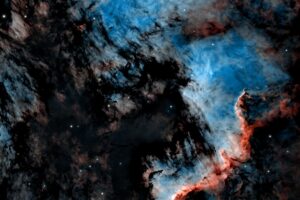
NGC 7000 — The North America Nebula Spanning over 100 light-years across and located about 1,600 light-years away in Cygnus, NGC 7000 is a vast emission nebula shaped uncannily like the North American continent. Its glowing hydrogen clouds and dark dust lanes form a rich tapestry of star formation, especially in the region known as the Cygnus Wall. Even with wide-field gear like the RASA 11, capturing the entire nebula in one frame is nearly impossible—its sheer scale demands mosaics or panoramic stitching to reveal the full structure.
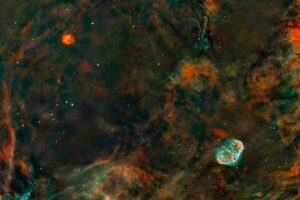
NGC 6888 & the Soap Bubble Nebula — Winds and Whispers in Cygnus The Crescent Nebula (NGC 6888) is a 25-light-year-wide shell of gas sculpted by the fierce stellar winds of WR 136, a massive Wolf-Rayet star nearing the end of its life. Its glowing arcs of hydrogen and oxygen trace the turbulent boundary between stellar fury and cosmic calm. Nearby, the elusive Soap Bubble Nebula (PN G75.5+1.7) floats quietly—discovered only in 2007 by amateur astronomer Dave Jurasevich. This faint planetary nebula, about 5 light-years across, marks the gentle final breath of a dying sun-like star. Together, they offer a striking contrast: one shaped by violent winds, the other by quiet release—two stellar endpoints captured in a single field of view
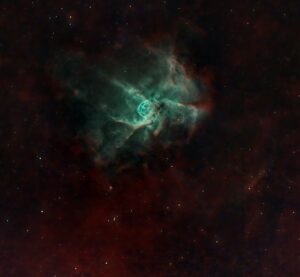
NGC 2359 — Thor’s Helmet Located about 12,000 light-years away in the constellation Canis Major, NGC 2359 is a wind-blown bubble of ionized gas shaped by the powerful stellar winds of WR 7, a massive Wolf-Rayet star nearing the end of its life. The nebula spans over 30 light-years and resembles the winged helmet of the Norse god Thor, with filamentary arcs and shock fronts sculpted by high-speed outflows. Its glowing structure is a vivid portrait of stellar evolution—where mass loss, radiation, and turbulence collide in deep space
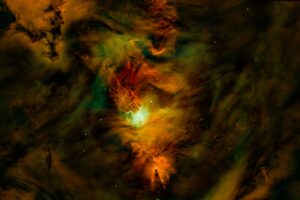
The Cone Nebula (NGC 2264) The Cone Nebula is a towering pillar of cold gas and dust, part of a much larger star-forming region. This dark, imposing structure, roughly 7 light-years tall, is being sculpted by the powerful stellar winds and intense radiation from massive young stars above it. o put that in perspective, the Cone Nebula would stretch across the equivalent of approximately seven thousand of our solar systems lined up end-to-end!" The Fox Fur Nebula (Sh2-273) The Fox Fur Nebula is a vibrant, reddish emission nebula that gets its name from its wavy, fur-like appearance. It's also part of the same colossal NGC 2264 complex, illuminated primarily by the hot, massive star S Monocerotis. This vast cloud of ionized hydrogen gas spans an area of many light-years, continuously glowing as it's energized by the intense radiation from nearby young stars. Its sheer size means it could easily engulf tens of thousands of our solar systems, with plenty of room to spare, highlighting the enormous scale of cosmic nurseries where stars are born.
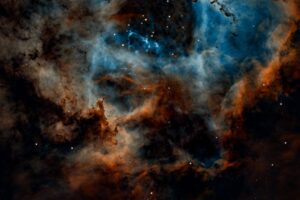
NGC 2237 — The Rosette Nebula Located about 5,000 light-years away in the constellation Monoceros, the Rosette Nebula is a sprawling star-forming region spanning over 130 light-years. Its rose-like shape is carved by intense ultraviolet radiation and stellar winds from the central cluster NGC 2244, which formed from the nebula’s own material. The glowing hydrogen gas and dark dust lanes trace the dynamic interplay of creation and erosion—where massive stars sculpt the clouds that once birthed them.
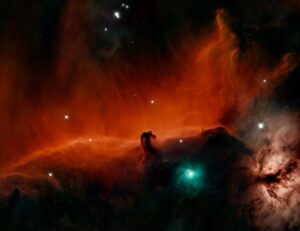
Barnard 33 — The Horsehead Nebula Located about 1,300 light-years away in the constellation Orion, the Horsehead Nebula is a dense pillar of cold gas and dust silhouetted against the glowing hydrogen backdrop of IC 434. Its iconic shape—resembling a horse’s head—was sculpted by intense ultraviolet radiation from nearby stars like Sigma Orionis, which also ionize the surrounding gas, causing it to glow red. This dark nebula is part of the larger Orion Molecular Cloud Complex, a rich region of star formation. Within its shadowed folds, gravity slowly collapses dense pockets of gas, giving rise to new stars hidden from view.
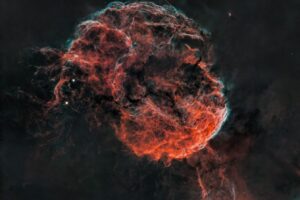
IC 443 — The Jellyfish Nebula Located about 5,000 light-years away in the constellation Gemini, IC 443 is a sprawling supernova remnant—the aftermath of a massive star’s explosive death some 10,000 to 30,000 years ago2. Its tangled filaments of glowing gas stretch nearly 70 light-years across, interacting with surrounding molecular clouds and shaping its complex, asymmetric form. Embedded within the nebula is a neutron star, the collapsed core of the progenitor star, silently drifting away at high speed. IC 443’s dual-shell structure and rich elemental emissions—iron, neon, silicon, and oxygen—make it one of the most studied remnants in the sky. Despite its violent origin, the Jellyfish Nebula now floats quietly at the foot of the celestial Twins, a haunting reminder of stellar impermanence.
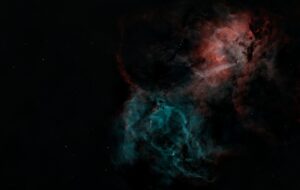
Sh2-132 — The Lion Nebula Roaring quietly from the constellation Cepheus, the Lion Nebula is a sprawling emission nebula located roughly 10,400 light-years away in the Perseus Arm of the Milky Way2. Its intricate structure glows with ionized hydrogen, sculpted by the intense radiation and stellar winds of massive stars—including Wolf-Rayet stars WR 153 and HD 211564, and several hot O- and B-type stars. The nebula’s faint surface brightness hides a rich tapestry of star formation, dark dust lanes, and bubble-like shells visible only through long-exposure imaging. Though elusive to the eye, the Lion reveals its cosmic mane in narrowband—where ultraviolet light ignites the gas into a fiery display of stellar evolution.
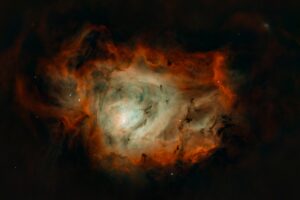
Messier 8 — The Lagoon Nebula Located about 4,000 light-years away in the constellation Sagittarius, the Lagoon Nebula is a vast stellar nursery glowing with ionized hydrogen gas. Spanning over 100 light-years, its bright core and dark dust lanes reveal the dynamic birthplaces of stars. Young clusters illuminate the surrounding clouds, carving out the nebula’s iconic lagoon-like shape
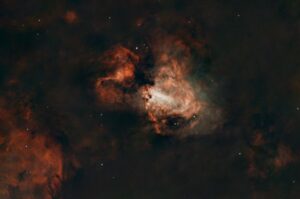
M17 — The Omega Nebula Located about 5,500 light-years away in the constellation Sagittarius, M17 is one of the Milky Way’s most massive and active star-forming regions. Also known as the Swan, Checkmark, or Lobster Nebula, its glowing hydrogen clouds are energized by a dense cluster of young, hot stars—many hidden behind thick curtains of dust. Spanning roughly 15 light-years, the nebula’s edge-on geometry reveals dramatic arcs, dark lanes, and sculpted shock fronts. The embedded cluster NGC 6618 drives the nebula’s luminosity, while ultraviolet radiation and stellar winds carve out cavities and ignite new waves of star formation. M17 is a cosmic forge—where gravity, heat, and time shape the next generation of stars in a luminous swirl of gas and dust
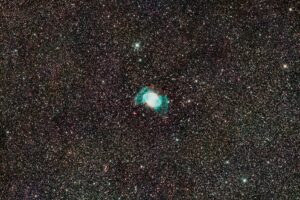
Messier 27 — The Dumbbell Nebula Located about 1,200 light-years away in the constellation Vulpecula, M27 is a planetary nebula—the glowing remains of a dying star. Its twin-lobed shape resembles a cosmic hourglass, formed as the star shed its outer layers into space. The vibrant hues of ionized hydrogen and oxygen trace the final breath of stellar life, offering a glimpse into the future fate of our own Sun
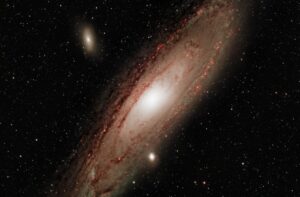
The Andromeda Galaxy (M31) The Andromeda Galaxy (M31) is the largest galaxy in our Local Group, a collection of galaxies that includes our own Milky Way. Located approximately 2.5 million light-years away, it's the most distant object visible to the naked eye, appearing as a faint, fuzzy patch on a dark night. This majestic spiral galaxy is a colossal city of stars, containing an estimated trillion stars, more than double the number in the Milky Way. Its grand design features prominent spiral arms, a bright central bulge, and several smaller satellite galaxies orbiting it. What makes Andromeda particularly captivating is its future: it's currently hurtling towards our Milky Way at about 110 kilometers per second (68 miles per second). In roughly 4.5 billion years, these two giant galaxies are destined to collide and merge, forming an even larger, more elliptical galaxy that astronomers have playfully nicknamed "Milkdromeda." This cosmic embrace will dramatically reshape our galactic neighborhood. Comparison with the Milky Way Galaxy While both are grand spiral galaxies, the Andromeda Galaxy is notably larger and more massive than the Milky Way. Andromeda boasts an estimated trillion stars and spans about 220,000 light-years in diameter. In contrast, our Milky Way contains roughly 200-400 billion stars and measures about 100,000 to 120,000 light-years across. So, Andromeda is roughly twice the diameter and contains 2 to 5 times more stars than our home galaxy, making it the undisputed heavyweight champion of our Local G
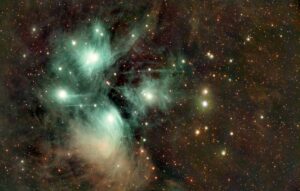
M45 — The Pleiades Located just 444 light-years away in the constellation Taurus, the Pleiades is one of the closest and most recognizable open star clusters in the night sky. Known since antiquity as the Seven Sisters, its brightest stars are hot blue giants, only about 100 million years old, still burning hydrogen in their cores. The cluster drifts through a region of interstellar dust, creating a delicate blue reflection nebula that wraps around the stars like cosmic silk. Spanning over 13 light-years, M45 offers a vivid glimpse into early stellar evolution—where youth, motion, and light converge in a tight celestial family.
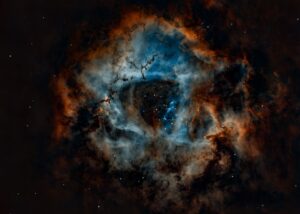
NGC 2237 — The Rosette Nebula Located about 5,000 light-years away in the constellation Monoceros, the Rosette Nebula is a sprawling star-forming region spanning over 130 light-years. Its rose-like shape is carved by intense ultraviolet radiation and stellar winds from the central cluster NGC 2244, which formed from the nebula’s own material. The glowing hydrogen gas and dark dust lanes trace the dynamic interplay of creation and erosion—where massive stars sculpt the clouds that once birthed them.
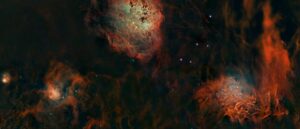
IC 405 & IC 410 — Fire and Formation in Auriga In the constellation Auriga, two nebulae share the frame but not the distance: IC 405, the Flaming Star Nebula, glows with a mix of emission and reflection, lit by the runaway star AE Aurigae, which wasn’t born here but blazes through the gas like a cosmic torch. IC 410, farther away and much larger, is a traditional emission nebula—home to the open cluster NGC 1893 and the famous Tadpoles, ten-light-year-long structures that may cradle newborn stars. Though they appear side by side, this pairing is a chance alignment—two stellar stories unfolding across vastly different scales and distances.
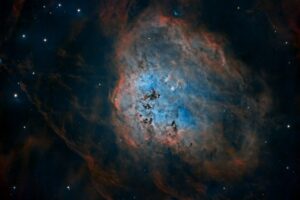
IC 410 — The Tadpoles Nebula Located about 12,000 light-years away in the constellation Auriga, IC 410 is a glowing cradle of star formation surrounding the open cluster NGC 1893. The nebula’s most iconic features—two elongated clouds of gas and dust known as the Tadpoles—stretch nearly 10 light-years across, shaped by stellar winds and radiation. These dense structures may harbor newborn stars, slowly emerging from the surrounding hydrogen-rich glow. Captured in narrowband, IC 410 reveals the dynamic interplay of light and shadow—where gravity, turbulence, and time sculpt the next generation of stars.
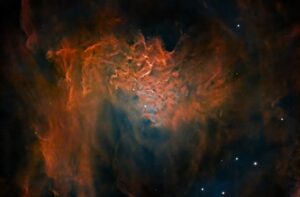
IC 405 — The Flaming Star Nebula Located about 1,500 light-years away in the constellation Auriga, IC 405 is a rare blend of emission and reflection nebulae. It surrounds the runaway star AE Aurigae, which blazes through the interstellar medium, igniting hydrogen gas and scattering blue starlight across nearby dust. The nebula’s fiery appearance is a product of motion and radiation—where stellar energy meets cosmic cloud, creating a glowing trail of light and turbulence. Though AE Aurigae wasn’t born here, its journey leaves a luminous signature in the sky.
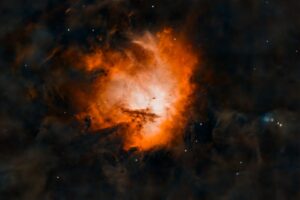
NGC 281 — The Pacman Nebula Located about 9,500 light-years away in the constellation Cassiopeia, NGC 281 is a vibrant emission nebula shaped by the energetic winds and radiation of young, massive stars. Its nickname comes from the dark dust lane that resembles the mouth of the classic arcade character Pac-Man. At its heart lies the open cluster IC 1590, whose O-type stars illuminate the surrounding hydrogen gas and sculpt dense pillars and Bok globules—potential birthplaces of new stars. Floating above the galactic plane in the Perseus Arm, this nebula is both playful in shape and profound in stellar activity.
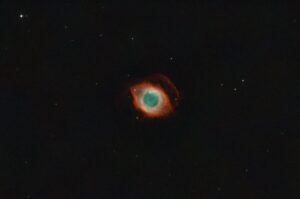
NGC 7293 — The Helix Nebula Located just 650 light-years away in the constellation Aquarius, the Helix Nebula is one of the closest and brightest planetary nebulae to Earth. Often called the Eye of God for its striking appearance, it marks the final breath of a sun-like star that shed its outer layers around 10,000 years ago, leaving behind a hot white dwarf at its center2. The nebula spans about 2.5 light-years, with glowing concentric shells of hydrogen and oxygen gas, and thousands of cometary knots—dense clumps of gas trailing away like cosmic streamers3. Its layered structure and symmetry offer a haunting glimpse into the future of our own Sun.
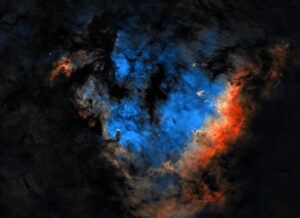
Cederblad 214 — The Heart of NGC 7822 Located in the constellation Cepheus, Cederblad 214 (C214) is the most luminous portion of the larger star-forming complex NGC 7822, about 2,400–3,000 light-years away2. This region glows with ionized hydrogen gas, sculpted by intense radiation and stellar winds from young, massive stars. Dense dust lanes and glowing pillars—sometimes called elephant trunks—trace the turbulent birthplaces of new stars. The embedded cluster within C214 is only a few million years old, making this a snapshot of stellar creation in progress
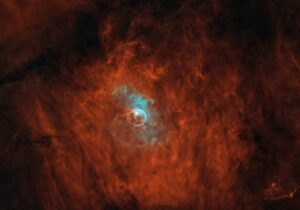
NGC 7635 — The Bubble Nebula Located about 7,100 light-years away in the constellation Cassiopeia, the Bubble Nebula is a glowing shell of ionized gas sculpted by the fierce stellar winds of a massive O-type star, BD+60°2522. This star, over 40 times the mass of our Sun, blasts out radiation and particles that carve a 7-light-year-wide bubble into the surrounding molecular cloud2. Despite its delicate appearance, the Bubble is a site of violent stellar activity—where energy, motion, and matter collide to shape the interstellar medium. Capturing it reveals the dynamic balance between pressure and gravity, chaos and symmetry.
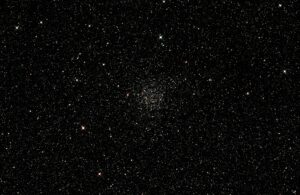
High in the constellation Cassiopeia lies a breathtaking cluster of thousands of stars, some glowing a deep red as they near the end of their lives. Known as Caroline’s Rose for its swirling, rose-petal shape, this cluster is about 7,600 light-years away and over a billion years old. I spent nearly 10 hours under the stars capturing this image to reveal its delicate beauty
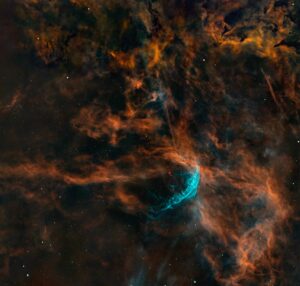
WR 134 — A Dying Giant in Cygnus Captured over 16 hours with a RASA 11 and ASI2600MC, this image reveals the faint nebula carved by WR 134’s stellar winds. The blue-green arc is ionized oxygen, shaped by the star’s intense radiation and motion. WR 134 is a Wolf-Rayet star nearing the end of its life — a cosmic sculptor preparing for its final supernova.
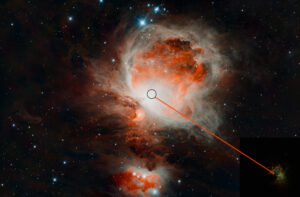
The Great Orion Nebula: A Star Factory in Our Cosmic Backyard If you’ve ever looked up at the winter sky and found the familiar three-star belt of Orion the Hunter, you’ve been tantalizingly close to one of the most breathtaking sights in the entire night sky. Hanging from his belt is his "sword," and what might look like a slightly fuzzy, faint star in the middle is anything but a single star. It’s the Great Orion Nebula, also known as Messier 42 (M42), a colossal cosmic cloud of dust and gas where stars are being born right now. At a distance of about 1,350 light-years away, M42 is the closest massive star-forming region to Earth. This makes it a favorite subject for astronomers and astrophotographers alike. When you look at an image of the Orion Nebula, you're not just seeing a pretty celestial cloud; you're peering into a stellar nursery, a chaotic and beautiful workshop of creation. _ What You're Seeing in the Picture The vibrant colors and intricate structures in a photograph of M42 tell a dramatic story: • The Glowing Pinks and Reds: The dominant, beautiful magenta glow comes from vast clouds of hydrogen gas. At the heart of the nebula, a group of massive, young, blazing-hot stars unleashes tremendous amounts of ultraviolet radiation. This energy excites the hydrogen atoms in the surrounding cloud, causing them to glow in this characteristic reddish hue—a phenomenon known as an emission nebula. Your specialized hydrogen filters are perfect for bringing out this spectacular detail. • The Ethereal Blues and Browns: The wispy, bluish areas are created by a different process. Here, the light from those same hot stars is simply reflecting off microscopic dust particles, much like how a streetlight illuminates fog. This is a reflection nebula. The dark, shadowy lanes that wind through the nebula are dense ribbons of interstellar dust, so thick they block the light from the glowing gas behind them. These are the raw, cold materials from which future stars and planets will be forged. • The Trapezium: At the very heart of the nebula is a tight cluster of four brilliant, newly formed stars, known as the Trapezium. These are the superstars of the region, born only a few hundred thousand years ago. Their intense stellar winds and radiation are the engine driving the entire spectacle, carving out a cavernous bubble in the surrounding cloud and lighting it up for us to see. _ A Violent Cradle: The Runaway Stars To gaze upon the Orion Nebula is to witness the same process that formed our own Sun and Solar System billions of years ago. It’s a dynamic, evolving landscape of cosmic gas, sculpted by the light of newborn giants. But a stellar nursery isn't always a peaceful cradle. About 2.5 million years ago, a chaotic gravitational encounter between two pairs of binary stars in this crowded region acted like a cosmic slingshot, flinging at least two massive stars out into space at over 200,000 miles per hour! These runaway stars, AE Aurigae and Mu Columbae, were ejected in opposite directions. Today, they are hundreds of light-years from home. AE Aurigae is now in the constellation Auriga, where its intense radiation is lighting up a completely unrelated dust cloud, creating the beautiful Flaming Star Nebula. This incredible story is a powerful reminder that the universe is not a static, silent place, but a constantly changing environment of birth, life, and violent renewal. Every astrophotographer, from the beginner with a DSLR to the seasoned expert, eventually points their telescope at M42. Its brilliance and complexity offer a rewarding challenge, and it never fails to inspire awe. About 8 hours of total exposure using: Telescope RASA 11 Camera ZWO 2600 color Mount CEM70AG _ M42 is 1350 light years away and about 24 light years across.