
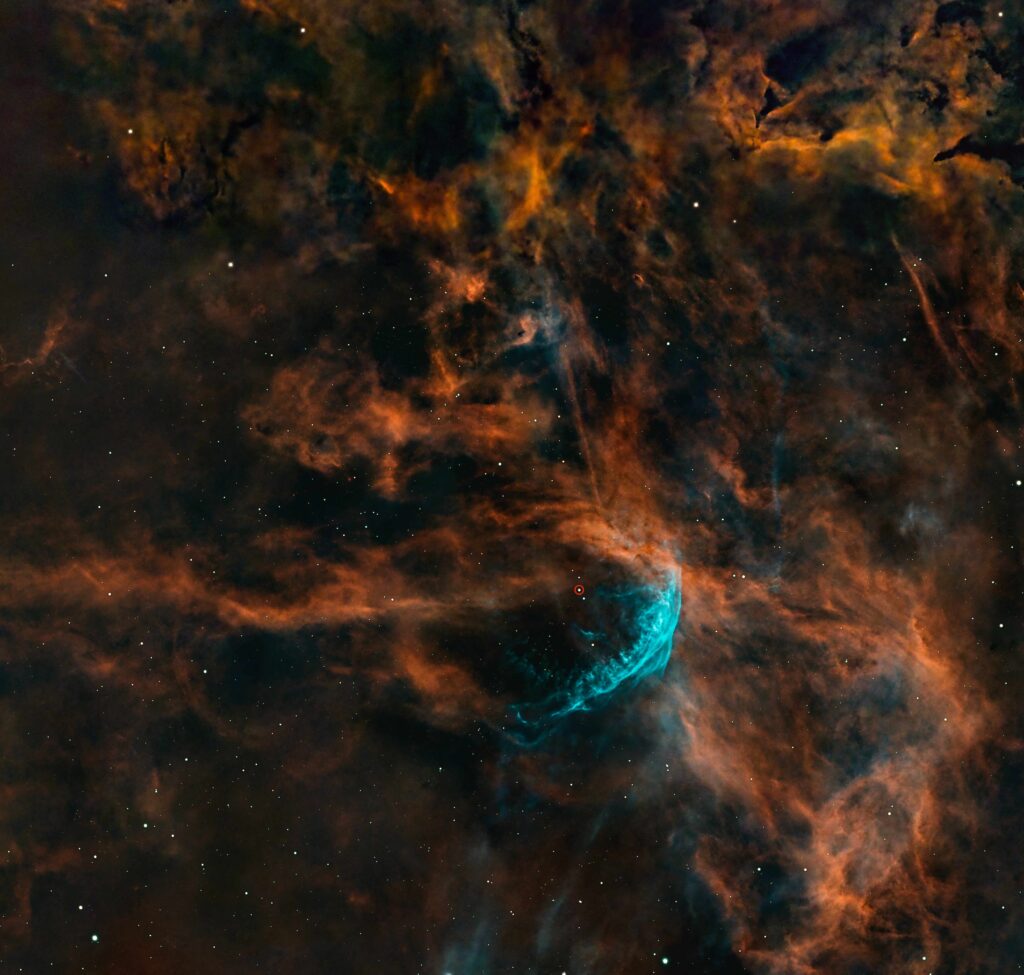
## A Cosmic Powerhouse: The Story of WR 134 🌌
Deep within the constellation Cygnus lies an object that tells a story of cosmic violence and fleeting beauty. A faint, ghostly shell of gas, visible only in long-exposure photographs, marks the location of WR 134, a rare and powerful Wolf-Rayet star on a path to self-destruction.
## The Nature of the Beast: A Wolf-Rayet Star ⭐
WR 134 belongs to a special class of stellar titans. Wolf-Rayet stars are massive, highly evolved stars that are nearing the end of their lives. They can be thought of as stellar onions that have violently shed their outer hydrogen layers, exposing their super-hot, turbulent cores.
This star is specifically classified as a WN6 type. The “W” is for Wolf-Rayet, and the “N” signifies that its spectrum is dominated by ionized nitrogen, the fused remnants of its former self. This tells us we are looking deep into the star’s interior, at layers that would normally be hidden from view.
## A Furious Stellar Wind
The most defining feature of WR 134 is its incredible stellar wind. It is continuously blasting its own mass into space at unbelievable speeds—around 1,900 kilometers per second (over 4.2 million miles per hour). This isn’t a gentle breeze; it’s a constant, high-speed eruption that causes the star to lose the mass of our entire Sun every 100,000 years.
This furious wind is the creative force behind the surrounding nebula. As this ultra-fast wind slams into the slower-moving interstellar gas, it creates a massive shockwave. This collision energizes the gas, causing it to glow and form the delicate, bubble-like structure seen in deep images. It is important to note that this beautiful shell is not the more famous Crescent Nebula (NGC 6888), which is powered by the nearby star WR 136.
## The Colors of the Cosmos
The stunning colors revealed in deep amateur and professional images showcase the complex physics of the nebula:
- The Blue-Green Glow: The most prominent color in the nebula is a distinct turquoise or blue-green. This is the signature of doubly ionized oxygen (OIII). The immense ultraviolet radiation pouring from WR 134 is so powerful that it strips two electrons from oxygen atoms in the shell, causing them to glow intensely in this part of the spectrum.
- Faint Red Hues: Woven into the background, hints of red or magenta can often be seen. This is the classic glow of hydrogen-alpha (Hα), the most common gas in this star-rich region.
## Vital Statistics & Location 🔭
- Constellation: Cygnus, The Swan
- Distance: Approximately 6,000 light-years from Earth
- Temperature: An incredible 79,400 K (over 142,000 °F)
- Mass: About 17 times the mass of our Sun
- Luminosity: Shines with the light of over 630,000 Suns
## A Violent Destiny 💥
The Wolf-Rayet phase is incredibly brief, lasting only a few hundred thousand years. Having already burned through its hydrogen and helium, WR 134 is in a race against time. Within the next million years, it will exhaust its fuel completely. Its core will collapse, triggering a cataclysmic supernova explosion (likely a Type Ib or Ic), which will briefly outshine entire galaxies.
The ultimate fate of its core remnant will be to collapse into a black hole, an invisible gravitational ghost left behind to mark the grave of a once-mighty star. Astro photographs of WR 134 capture one of the final, beautiful acts before the curtain falls on this stellar titan.
Imaging WR 134: Capture and Processing
This image was acquired using:
- Telescope: RASA 11 (f/2.2)
- Camera: ZWO ASI2600MC (cooled color CMOS)
- Mount: CEM70AG
- Exposure: 16 hours total, with 3-minute subframes
- Stacking: Deep Sky Stacker
- Gradient Removal & Stretching: GraXpert
- Final Touches: Affinity Photo