
Welcome to my astrophotography blog! After years of studying the stars through science, and curiosity, I’ve finally created a place to share the images and stories behind my nights under the vast sky.
My observatory in Middle Tennessee, houses a RASA 11 telescope paired with a ZWO 2600 color camera, supported by narrowband filters for capturing faint details in hydrogen and oxygen. With this setup, I chase galaxies, nebulae, and all deep sky objects—trying to bring out the hidden colors and energy that our eyes can’t see on their own.
Here on the blog, I’ll be posting:
- My latest deep-sky images, along with capture and processing notes
- Experiments with gear, filters, and software
- Occasional reflections on the science and wonder of what I capture
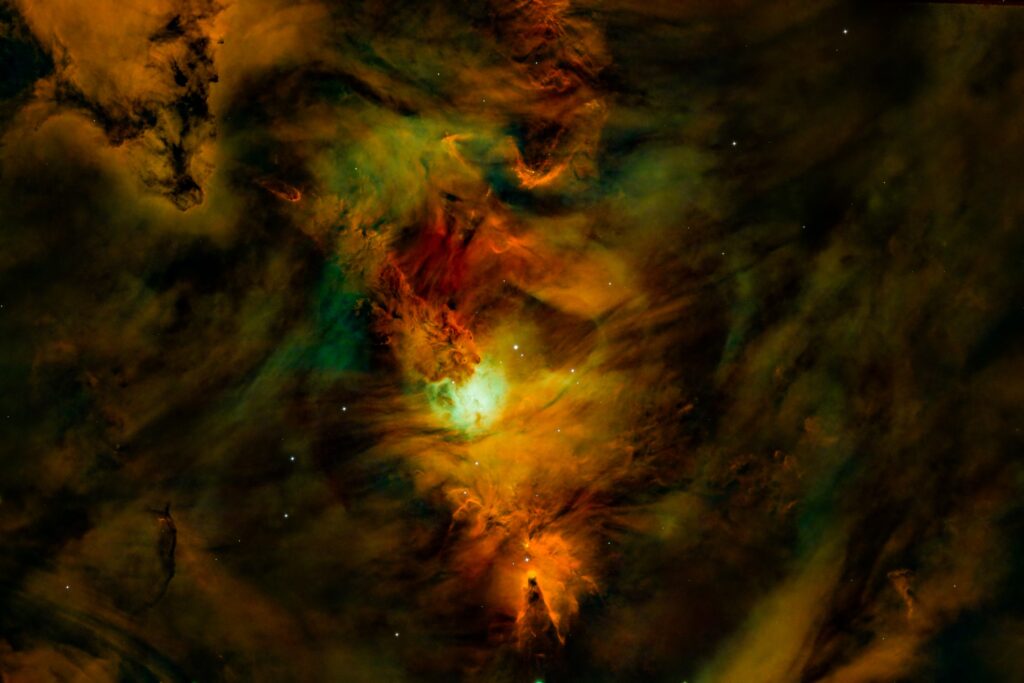
NGC 2264 – The Christmas Tree Cluster and Nebula
Data for this image was acquired in 2022 from Tennessee, USA.
I captured about 24 hours of exposure time, using 3-minute subframes.
Equipment & Processing
- Telescope: RASA 11
- Camera: ZWO 2600
- Mount: CEM70
- Acquisition Software: NINA
- Stacking: Deep Sky Stacker
- Post-Processing: GraXpert for gradient removal and stretching, final adjustments in Photoshop
About NGC 2264
NGC 2264, often called the Christmas Tree Cluster and Nebula, lies in the constellation Monoceros, about 2,500 light-years from Earth. This star-forming region is a rich combination of open cluster and emission/reflection nebulae, making it a favorite for both visual observation and astrophotography.
NGC 2264 isn’t a single object but a complex that includes three distinct parts:
1. Cone Nebula
- Structure: A towering dark pillar of cold molecular gas and dust, stretching about 7 light-years in length.
- Formation: Its shape has been carved by powerful ultraviolet radiation and stellar winds from nearby hot, young stars. These forces both erode the pillar and trigger new star formation within it.
- Visuals: Against the surrounding glow of ionized hydrogen, the Cone stands out as a striking shadowy figure, its tip pointing downward in most images.
- Scale: To put its size in perspective, the Cone Nebula is more than 3,000 times longer than our solar system (measured out to the edge of the heliosphere).
2. Fox Fur Nebula
- Location: Found near the bright star S Monocerotis.
- Structure: Named for its fur-like texture, it is a region of gas and dust shaped by stellar radiation and winds.
- Color: Glows with the deep red of hydrogen-alpha emission, interspersed with blue reflection from starlight scattered by dust.
- Significance: This area remains an active star-forming region, continually reshaped by the energy of its young stars.
3. Christmas Tree Cluster
- Stars: Contains around 600 young stars, dominated by the hot, blue-white O-type star S Monocerotis.
- Age: Just a few million years old, making it a very young open cluster.
- Appearance: The stars appear arranged in a triangular “tree” shape, with S Mon at the base acting as the trunk.
- Dynamics: Many stars are still partially enshrouded in their natal gas and dust, and some host protoplanetary disks, hinting at future planetary systems.
Why It’s Special
NGC 2264 beautifully combines dark nebulae, emission regions, reflection nebulae, and a young star cluster all in one field. Its mix of structures makes it an excellent astrophotography target — rich in color, detail, and scientific interest.
It remains a winter favorite for imagers and observers alike, a glowing reminder of the active, ever-changing processes shaping our galaxy.